faith and festivals, marble, wine, and things to do
The cultural layer of Tinos — its feasts and pilgrimage, the marble museums, the wineries, and ways to spend a day. Pick a category from the toggle, then jump to any entry from the contents.
ContentsFaith & festivals
The Panigiria
The Tinos Festival
Churches & Monasteries
The PanigiriaTinos's summer feast nights
AThe calendar
Most panigiria fall on a fixed saint's day, so the dates barely move year to year — the trick is knowing which are worth a guest's evening (see below). The summer ones generally worth going to:
17 Jul
Falatados · Agia Marina
20 Jul
Kardiani · Profitis Ilias (confirm)
26 Jul
Pyrgos · Agia Paraskevi (confirm)
27 Jul
Ktikados · Agios Panteleimon (confirm)
6 Aug
Arnados · Metamorfosis
29 Aug
Komi · Beheading of St John (confirm)
Plus the food festivals — Steni's capers (July), Komi's artichokes (May). The big island-wide religious days (25 March; 23 July, Agia Pelagia; 15 August, Dormition) are pilgrimage occasions to witness rather than village parties, and 15 August overwhelms Chora. The Easter-linked feasts move each year; for 2026 (Pascha 12 April): Zoodochos Pigis 17 Apr, Ascension 21 May, Holy Spirit Monday 1 Jun.
the village cultural-association Facebook pages for the confirmed night and band (they firm up June–July).
Dates follow the saints' calendar and the host village can vary; the night a feast actually runs — and whether it runs at all — is confirmed locally each summer. Check with your host or the village association before setting out.
BWhat a panigiri is — and which to go to
A panigiri is a village's feast for its patron saint: a church service, then the whole village eating, drinking and dancing together late into the night. But they aren't all the same evening, and the difference matters for a visitor.
The local, religious panigiria belong to the village — tied purely to the saint's day, run by the church and the parish families, and not put on for outsiders. Some are little more than the liturgy and a modest gathering of the few households tied to that chapel. You're welcome the way any guest is welcome in Greece, but you're at someone else's occasion, not the audience, and turning up at a tiny one can feel like intruding.
The organised festival panigiria are the ones to aim for. Run by the village cultural association (politistikos syllogos), these are proper events — often a small entrance ticket or a set price for the food, a printed programme, hired musicians, long tables, a kitchen feeding hundreds, sometimes parking and a shuttle. Live music is all but guaranteed and the welcome is open to everyone. These are the ones worth driving out for.
CThe night, the music, and the dancing
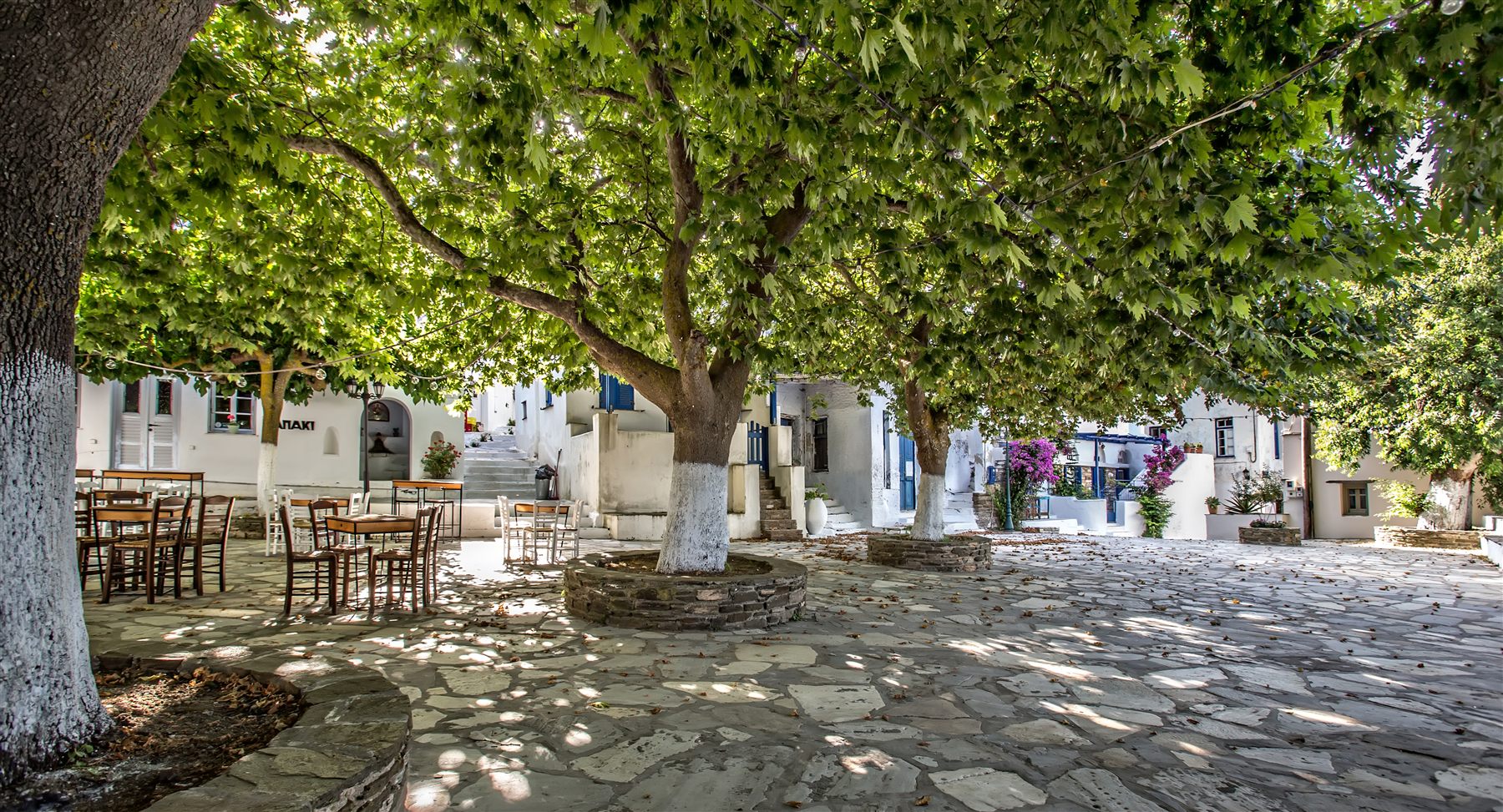
The shape is old and consistent: it opens at the church with vespers and the saint's-day liturgy, often the evening before, sometimes with the icon carried through the village in procession. Then the feast begins in the square — village-cooked food at long tables, local wine and raki, and music that builds slowly and runs past midnight, often till dawn.
The music is nisiotika, the island folk songs of the Aegean. The Cycladic sound is led by the violin and the laouto — a long-necked lute carrying the rhythm and chords — lighter and more melodic than the lyra-driven music of Crete, with a Byzantine and Asia Minor colour and a bright, ringing vocal line. The musicians take requests, and the night moves at the pace of whoever's on their feet.
The dancing centres on the syrtos — an open circle of dancers linked hand to hand, the leader at the front improvising while the line follows. You don't need to know the steps: join the back of the circle, watch the feet in front of you, and you'll have it within a song. Nobody minds a visitor learning; it's half the point.
DGetting there and back
You'll need a car: the villages are scattered up in the hills and there's no late bus home. Expect to park well below or behind the village and walk up — these are dense old settlements of narrow lanes, and the square fills early. The bigger organised feasts sometimes run a shuttle, from Chora or between the parking and the village centre, but don't count on it. Bring cash for the food and any ticket. And don't drink and drive — the roads back are dark, narrow and winding, so make sure you've a sober driver, or stay until you're fit to drive.
The Tinos Festival / Foundation of Tinian Culturethe island's cultural centre · Chora seafront
Quite separate from the panigiria, this is the Tinian community's own cultural centre — the Foundation of Tinian Culture (Ι.ΤΗ.Π.), in the neoclassical building on the Chora seafront. Through the year it mounts exhibitions in its galleries; over the summer it also runs a programme of theatre, concerts and other events (the long-running Jazz on Tinos among them). What's on, and when, lives in the calendar on its website.
Most events are in Greek. Some run in English or offer language assistance, so if language matters for what you're booking, it's worth checking ahead.
The spiritual heart of the island and one of the most important Orthodox pilgrimage sites in Greece. The grand marble church crowns a processional avenue rising from the port; pilgrims climb the final stretch — some on their knees — to venerate the miraculous icon of the Virgin, found here in 1823. The complex also holds the Museum of Tinian Artists, the Art Gallery, the Sacristy of religious silver and gold, and the Mausoleum of the warship Elli, torpedoed in Tinos harbour on 15 August 1940.
Worth knowing
Modest dress (shoulders and knees covered). Open daily; entry is free.
One of the oldest and largest nunneries in Greece, set high in the hills with panoramic views over the Aegean. This is where the nun Saint Pelagia had the vision in 1822 that led to the icon's discovery; her cell and relics are venerated here, and the icon returns each 23 July. Quiet, working, and deeply atmospheric — worth the drive up.
A reminder that Tinos has one of Greece's largest and oldest Catholic communities — the island is shared between Orthodox and Catholic villages. The Ursuline convent and school, founded in 1862, sits in green Loutra with its cloister and gardens; the quiet Serviam café occupies part of the old complex.
venetian fortress · medieval capital · hike & views
The Venetian fortress hill at the centre of the island — Tinos's medieval capital, with Catholic churches and ruins scattered up its slopes. The short, steep climb to the summit is one of the best quick hikes on the island, with views across the whole of Tinos and out to the neighbouring Cyclades.
Four fixed days anchor the island's religious calendar:
30 January
Anniversary of the icon's discovery (1823); processions in Chora.
25 March
The Annunciation (Evangelismos) — a major pilgrimage day.
23 July
Saint Pelagia; the icon travels up to Kechrovouni Monastery.
15 August
The Dormition of the Virgin (Megalochari) — the island's biggest day, when thousands of pilgrims arrive and the icon is carried through Chora. Book everything far ahead.
Worth knowing
Magnificent to witness, but Chora is overwhelmed around the 15th — plan beach days, not town days, that week.
ContentsFive museums
IMuseum of Marble Crafts
Pyrgos · €8 · 10:00–18:00, closed Tue
The island's finest sculpting museum, and a beautiful building in its own right — a modern, state-of-the-art complex on the slopes above Pyrgos, the marble village that produced so many of Greece's great sculptors. It traces the whole craft from quarry to finished work — the tools and techniques, films of the last traditional quarrymen, and outdoor terraces of marble works and old hoisting machinery. What comes through is how completely marble shaped the island's sacred and civic life: the iconostases and bishops' thrones of its churches, the carved fanlights and fountains of its villages, the tombstones of its dead. Displays are translated into English.
A contemporary-art museum in the village of Kampos, in the renovated former primary school, redesigned by architect Manos Perrakis in the island's own language of whitewash and stone, looking out over the Messaria valley toward Mt Exomvourgo. It's the 'spiritual child' of Costas Tsoclis, one of Greece's foremost contemporary artists, whose work is steeped in the Aegean and the sea; his great St George and the dragon stands in the courtyard as the museum's emblem. The displays rotate each year, with talks, screenings and performances through the summer.
Two doors of the same story, on one ticket: a gallery of work by the painters and sculptors this one village sent out across Greece, and the preserved home of Yannoulis Halepas, the tormented genius of modern Greek sculpture.
The Foundation of Tinian Culture's gallery on the waterfront (Akti G. Drosou), with changing exhibitions through the year — the same centre behind the summer festival programme (see The Tinos Festival above).
The island's most acclaimed winery, set in an extraordinary landscape of huge granite boulders above Falatados. Intimate guided tastings in the vineyard, led privately — the granitic terroir and the wild setting are half the experience. Assyrtiko and Mavrotragano are the signatures. Book well ahead.
A contemporary winery on the road toward Loutra, with vineyard and Aegean views, organic production and a beautiful tasting platform looking out toward Exomvourgo and the sea. More accessible and lower-key than T-oinos; a good pairing with a drive through the island's centre.
A family winery in the mountain village of Steni — tasting alongside à la carte food, the most personal of the three. Worth combining with a visit to Steni village itself.
~150 km · spring & autumn ideal · walk early in summer
Tinos has one of the best-marked trail networks in the Cyclades — around eleven restored footpaths totalling some 150 km, the old stone routes that once linked the villages. They thread past dovecotes, chapels, terraces and the boulder fields; the Volax–Falatados loop and the marble route are among the most rewarding. Spring and autumn are ideal; in summer, walk early.
Worth knowing
The network is signposted; route maps are available online — add the official trails link.
Private boat charters run from the port for a day around the island's coves and sea caves, or across to Delos and Mykonos; smaller speedboat tours and fishing trips are easy to arrange. The most beautiful, otherwise-hard-to-reach beaches open up from the sea. Book a day or two ahead in high season.
Before you book
Agree the cancellation policy with the operator up front — boat trips can be called off when the wind blows Beaufort 5 or higher.
Beginner-friendly surf school at Kolymbithra — the island's best learning beach, sandy-bottomed with an easy paddle-out. The meltemi is what makes it work: lessons run from Beaufort 5 (17–21 kts) upward, so check conditions before making the drive.
The Tinian craft brewery Nissos offers tours with sweeping Cycladic views — Syros, Delos, Mykonos, Paros and Naxos on the horizon — and a tasting of beers brewed on the island. A relaxed, family-friendly stop off the beaten track.
 Horizon Villas