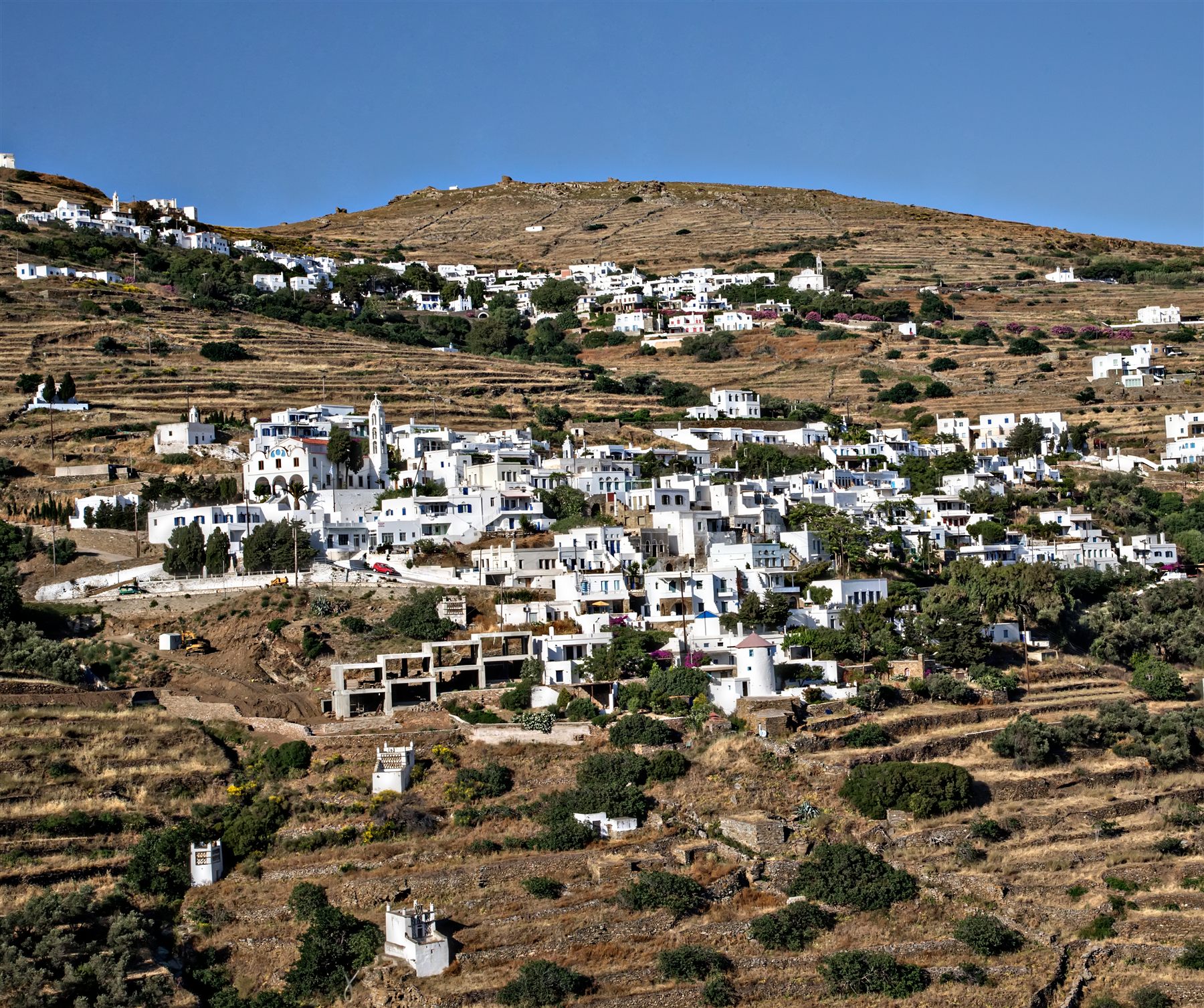
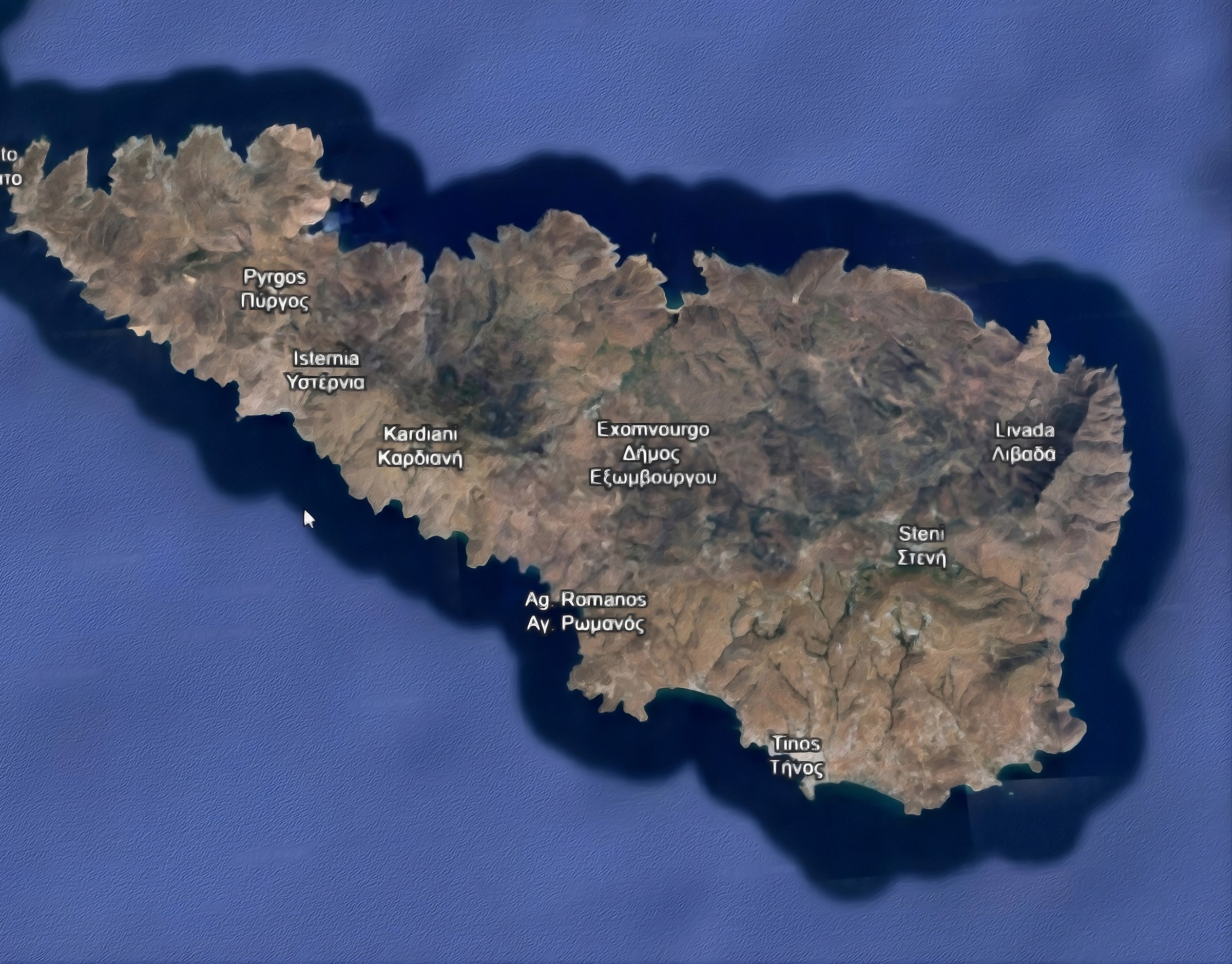
One of the closest villages to the bay, on the old eastern road just above Chora. Triantaros sits on the slope with long views down to the sea, a handful of churches, and a small shaded square. It's an easy first village to wander — whitewashed lanes, the occasional cat, a couple of terraces with a view. It's usually seen as a trio with neighbouring Dyo Choria and Arnados, higher up the same road.
What to do
Stroll the lanes and the square, then a meal with a sea view at Triantaraki, or drinks at Labo Bar.
One of the largest and most lived-in villages on the island, set in green country near the Falatados vineyards. Orthodox and Catholic communities have long lived here side by side, each with their own churches. It feels like a working village rather than a postcard — cafés and tavernas that stay open through the year and a genuine local rhythm. Walk into its heart and it feels properly traditional and authentic, refreshingly free of cars. Its caper festival in July is the big day of its calendar.
What to do
Wander between the two communities’ churches and squares, then eat at Duar.
Unlike anywhere else in the Cyclades — a tiny village (around forty residents) set in a surreal field of giant granite boulders, some the size of houses. It's one of the oldest settlements on Tinos, with a long basket-weaving tradition still practised here and a small open-air theatre among the rocks. Locals have hung hand-painted poems on doors and walls through the lanes. The country around the village is greener and softer than the boulders suggest, with a broad fertile plain opening out below — magical at sunset.
What to do
Walk the boulder field and the poem-lined lanes, look in on the basket weavers, then take in the plain below as the sun goes down. Eat at Aeraki Tiniako.
Best time
Spring, when the surrounding country turns lush and verdant — almost Italian countryside.
Small, understated, and one of the prettiest places to pass through on the island, just off the road between Chora and Kionia. Cobbled lanes run under marble archways, houses carry marble-latticed windows, and there are old fountains where carpets were once washed. The views open out toward Kionia and the sea. Worth a short stop even if you're only driving by.
What to do
A short walk through the archways and fountains, with a meal and a view at Drosia.
A fertile farming village in a green valley in the middle of the island, on the way toward Kolymbithra beach. It's quiet and unshowy, ringed by fields and gardens, and known for its produce — the artichoke festival in May is its moment. Few day-trippers stop, which is part of the appeal. Mostly it's a place to eat well and slowly.
What to do
A wander around the village and a long dinner on its big square — home to Svoura and Calais Bar — with a quiet, easy energy. Popular in summer, and a perfect stop for dinner after an afternoon at Kolymbithra.
One of the most beautiful villages on the island — and the one our sister property is named for. Built amphitheatrically into the green slope of Mt Pateles, high above its own bay, it's unusually lush, with spring water running through stepped lanes, plane trees, marble fountains, and vaulted arcades. Orthodox and Catholic churches sit close together, and it holds official ‘traditional settlement’ status. Split between the upper village and Ormos Kardiani down at the bay, it looks out over sweeping views of the archipelago, with some of the most incredible sunsets on the island.
What to do
Climb the stepped lanes to the square, follow the water down through the village, and time dinner for sunset.
Best time
Golden hour — walk up to the square as the sun goes down.
Eat & drink
Dimitra's Café — authentic, with little mezes and desserts — and Perivoli, a lovely garden with a view for lunch.
Built amphitheatrically on the slope of Meroviglia, with sweeping views over the Aegean toward Syros, Isternia is the island's second marble village after Pyrgos — and it shows, in the carved fountains, lintels, and church details. It glows in the late-afternoon light, which is when locals say to come. Below the village, a road winds about five kilometres down to Ormos Ysternion, the old harbour where the Piraeus boats once docked and where Thalassaki now sits out on the jetty.
What to do
A wander through the marble lanes, a sunset drink at Mayou, then dinner down at the bay.
Best time
Afternoon into sunset, for the colours over Syros.
The largest village after Chora and the heart of the island's marble tradition. Its famous square — a marble fountain, cafés, and a giant plane tree for shade — is the place for a coffee and a slice of galaktoboureko. The lanes are full of marble doorways, reliefs, and fountains, with small design shops between them, and three museums sit close together: the Museum of Marble Crafts, the Museum of Tinian Artists, and the preserved home of the sculptor Yannoulis Halepas. Many of Greece's great sculptors were born here.
What to do
The marble museum and the Halepas house, the workshops and shops, coffee and galaktoboureko in the square.
The northern tip of the island and a working fishing harbour, about 3.5km beyond Pyrgos. Brightly painted boats tie up along the quay, which is lined with tavernas and cafés, and across the water sits the islet of Planitis with its 1886 lighthouse. It has an end-of-the-road feeling — quieter, saltier, built around the sea rather than marble. Sandy Rochari beach and the cove of Agia Thalassa are both a short hop away.
The eastern end of the long Agios Ioannis bay — a thin, long stretch of fine sand running from the Agios Sostis church down toward Laouti. The water is generally shallow, varying a little from one part of the beach to the next, so it stays easy for wading and a safe bet with small children. There's little protection from the wind.
Sand & depth
Fine sand; generally shallow, varying a little along the beach — easy wading
Access & parking
Eastern end of the Agios Ioannis bay, with parking near the Agios Sostis church. About 5.5km from Chora, or a short walk along the bay from Agios Ioannis Porto.
Wind
Little protection from the wind.
Beach bar
The Cavos and Byzantio hotels each run their own beach bar — both quiet and simple.
A long stretch of sand running from the edge of Tinos town out to Akra Ourio — the far half is the better part, wider and completely sandy. The water is generally shallow, varying a little along its length, and for the most part deepens only gradually, so you can walk out a good way before it reaches swimming depth. The open beach catches the wind, though many of the beach bars stay sheltered out as far as their sunbeds.
Sand & depth
Long sandy stretch — the far half wider and fully sandy; generally shallow, deepening only gradually
Access & parking
Runs from the edge of Tinos town to Akra Ourio — walking distance or a very short drive from Chora.
Wind
The open beach catches the wind, though many beach bars stay sheltered out as far as their sunbeds.
Beach bar
Elia is the relaxed choice, Sundara the livelier one, and Almiry sits between the two.
A sandy beach reached by heading down through Vourni. The water deepens gently to a moderate depth, and there's reasonable shelter from the wind — far more of it right at the beach bar. Bianco Beach Club wraps around much of the sand, so it's worth coming to Ballos mainly if you plan to lounge at Bianco — and to book ahead.
Sand & depth
Sandy; deepens gently to a moderate depth
Access & parking
Down through Vourni (past Kionia, about 6km from Chora). Parking is difficult, though Bianco runs a valet service.
Wind
Reasonable shelter from the wind, and far more right at the beach bar.
Beach bar
Bianco Beach Club wraps around much of the sand — book ahead.
A sandy beach that curves around the whole bay, varying in width as it goes, with a small coastal settlement on its eastern side. The water is generally shallow, varying a little around the bay, so for the most part you can wade out a long way. It's well protected from the wind — the island's reliable fallback when the meltemi is up.
Sand & depth
Sand curving around the bay, varying in width; generally shallow — wade out a long way
Access & parking
Drive down to the settlement; parking along the road and a small car park.
Wind
Well protected — one of the best options when a north wind is blowing.
Beach bar
Lefko sits at the far end, with a few restaurants alongside the sand.
A wide, generous stretch of sand on the sheltered south coast. The water is a moderate depth, and the beach is well protected from the wind — easy and low-key.
Sand & depth
Wide, generous sand; moderate depth
Access & parking
Head down toward Ormos Kardianis and turn left at the fork; a large car park right by the beach.
A small sandy beach in the bay below Isternia village, at the old harbour of Ormos Ysternion, with very clear water looking toward Syros — easy to pair with a stroll along the bay.
Sand & depth
Small sandy beach, very clear water
Access & parking
Ormos Ysternion, about 17km north-west of Chora, down the road from Isternia village; parking can be difficult in peak season.
Wind
Not especially protected from the wind.
Beach bar
No beach bar, though the harbour tavernas — Thalassaki on the jetty among them — sit right behind.
A sandy beach of medium length and width, past Panormos. The water is shallow and deepens slowly. Wind protection is low, and there are no beach bars — bring what you need.
Sand & depth
Sandy, medium length and width; shallow, deepening slowly
Access & parking
Past Panormos — after the village, turn right and follow the coast; parking along the access road and a small plot beside the beach.
A very wide sandy beach east of Panormos, with trees set back from the shore for shade. The water is a moderate depth, deepening at a steady pace. There's little wind protection, and because it faces north the water isn't always clear after a windy spell.
Sand & depth
Very wide sand, trees set back for shade; moderate depth, deepening at a steady pace
Access & parking
East of Panormos along the coastline; parking along the road and a large area near the beach.
Wind
Little protection; north-facing, so the water isn't always clear after a windy spell.
On the north coast — sandy, with pebbles underfoot in the water. The bottom drops off quickly, so it's deep close to shore. There's no protection from the wind: open to the northerlies, which makes it less suited to calm swimming but very good for surf. The beach bar has an alternative, surf-led feel.
Sand & depth
Sandy, with pebbles underfoot in the water; drops off quickly — deep close to shore
Access & parking
Drive down toward the beach (down through Komi, ~14km from Chora); parking along the road.
Wind
No protection — open to the northerlies. Less suited to calm swimming, very good for surf.
A large, wide beach of golden sand, ringed by rock formations. The water is a moderate depth, deepening at a steady pace. Wind protection is low, and there are no beach bars — bring what you need.
Sand & depth
Large, wide golden sand ringed by rock formations; moderate depth, deepening at a steady pace
Access & parking
Drive toward the beach and park near the Country Club, then walk about 100m through the fields to the shore — bring walking shoes.
Wind
Low protection from the wind.
Beach bar
None — bring water, shade and everything you need.
A wild, undeveloped sandy beach framed by smooth rock formations on the far north-east coast. The water starts at a moderate depth but drops off to deep quickly. Wind protection is low — best avoided when the wind is above about 5 Beaufort. Striking to look at, but worth visiting only on a calm day.
Sand & depth
Sandy, framed by smooth rock formations; starts at a moderate depth, then drops off to deep quickly
Access & parking
A long drive out, ending with about ten minutes of dirt road — an SUV is recommended.
Wind
Low protection — best avoided when the wind is above about 5 Beaufort.
Beach bar
None on the beach, though a small taverna sits nearby (Livada Restaurant).
The Municipality of Tinos's own mapped trail network — routes across the island in all directions, each with distance, duration and difficulty. Spring and autumn are the ideal seasons; in July and August go early and avoid midday. The website and app carry all routes in English, Greek and French.
An ouzeri-taverna on the edge of Chora, right by Agios Fokas beach. The dining room is themed on the folk tale ‘The King and the Salt’, with framed scenes from it along the walls. The cooking is seafood-led, built around small plates and fish — taramosalata, marinated anchovies, salted sardines, grilled shrimp, smoked aubergine — with veal and pork for meat-eaters. Best known for its seafood mezedes.
On the waterfront at the far end of the main port in Chora, tables set by the sea. The kitchen leans on fresh fish but also does meat, with a Greek wine list to match. The large fresh fish, served with its basmati rice, is the thing to order.
A small ouzeri in the centre of Chora — an old-style room with a short menu of mezedes meant to go with a carafe of ouzo or wine, and live music on some weekends. Best known for its seafood mezedes.
Set in a garden near the old port in Chora — full name ‘Itan Ena Mikro Karavi’ (It Was a Little Boat). The cooking is creative modern Greek on local produce, with vegan and vegetarian options and a cellar of more than sixty Greek wines, around twenty of them Tinian. The cuttlefish-ink risotto and the pitas are the dishes to order.
A family taverna in the small village of Ktikados, with tables on a vine-shaded balcony facing Kionia and the sea. The food is traditional Tinian — meatballs, froutalia, local cheeses, hand-cut fries, homemade desserts — built around the day’s cooked dishes.
A taverna in the small village of Chatzirados, just inland from Chora. The name — ‘Wood & Cast Iron’ — points to a charcoal grill. The braised pork leg and the mushroom pasta are the dishes to look for. Cuisine, setting and hours still need confirming.
A village taverna in Steni, the largest of the inland villages, set under a large plane tree. The cooking is classic Greek, strongest at the grill — the lamb chops especially.
A taverna on the main square in Komi, in the island’s artichoke-growing country. The kitchen works around mezedes — the zucchini chips and the braised beef tongue among the dishes to order.
A taverna in the boulder village of Volax, opposite the small stone theatre, in the spot long held by ‘Rokos’. The cooking is Tinian classics from local produce alongside charcoal-grilled meats — kopanisti and island cheeses, tomato and fennel fritters, froutalia, oven-cooked goat and braised veal. The fried fritters and the lamb chops are the ones to order.
Hours
Daily — Tue 12:00–21:00; Wed, Fri, Mon 12:30–22:00; Thu 12:00–22:00; Sat 13:00–23:00; Sun 12:00–23:00
A taverna in Isternia village that opened in spring 2024, on the cliff facing the bay toward Syros. The food is traditional Greek, stronger on slow-cooked and meat dishes than on fish. Its starters are the thing to begin with.
On the jetty at Ormos Ysternion (Isternia bay), with tables at the water’s edge facing Syros. The cooking is creative Greek with a seafood focus; booking ahead is advised. The risotto is the dish to look for.
A waterfront restaurant at Isternia bay, tables set right by the water — the name means ‘On the Sand’. The cooking is Greek, leaning seafood. Best known for its seafood mezedes. The full name, menu and hours still need confirming.
An all-day restaurant-bar with tables on the marble square in Pyrgos, under the bell tower and the great plane tree. It runs from breakfast and brunch through to dinner, with homemade dishes from local ingredients, good coffee and fresh bougatsa.
An all-day spot just off the main square in Pyrgos, serving Italian food — pizza and pasta from dough made by hand each day — alongside cocktails, from morning coffee through to late-night drinks. The pizzas and pastas are what to order.
A harbour taverna on the quay at Panormos, with tables by the fishing boats. The cooking is traditional, built on fresh fish and seafood — the fried mullets especially. As is standard where fish is sold by weight, ask for it to be weighed and priced before you order.
An all-day café-bar in the neoclassical house of the Foundation of Tinian Culture, right on the Chora seafront with a clear view over the old harbour. It runs from the first speciality coffee of the morning (single-origin beans from Brazil, Ethiopia and Burundi) through brunch — kagiana, poached eggs with salmon, an açai bowl — to cocktails at night. The name is the wild-artichoke flower, and the kitchen takes a fresh, modern line on local flavours. Grab an outside table for the ‘Before Sunset’ cocktail as the sun drops behind Syros.
Hours
Tue & Sun 09:00–23:30; Wed–Sat 08:00–23:30; Mon 08:00–16:00
A relaxed all-day spot in Chora trading on ‘island vibes’ — coffee and brunch early, cocktails and a party mood as the day goes on. Easy, young, and central. Good for a laid-back daytime coffee that can roll into evening drinks.
A small, quiet café tucked inside the old Ursuline monastery-and-school complex in Loutra, about 15 minutes from Chora. The setting — stone, shade and cloister calm — is the whole point; it's a peaceful coffee stop rather than a buzzy one, and its name is the Ursuline motto, Latin for ‘I will serve.’ Often tied to cultural events at the complex, so opening can be seasonal — worth checking.
A dependable little café in the Chora laneways with well-made coffee and a nice spread of food — a good, unfussy choice for breakfast or a daytime bite in town. (Not to be confused with the Mikro Karavi restaurant.)
A café on Pyrgos's beautiful marble square, in a fully renovated old building that was once the village's traditional kafeneio — now a calm, almost Zen mix of modern and traditional under the plane tree. The place for a coffee and something sweet (the banoffee and the galaktoboureko get singled out) while you take in the square. Pairs perfectly with a wander round the marble museums.
A small, modern Chora café-bar known for good speciality coffee and savoury cocktails, with breakfast and light bites too — vegan options included, which is still a rarity on the island. They also sell organic and handmade local products. Easygoing by day, more of a drinks spot in the evening.
Many people's favourite bar on the island — an all-day spot in Isternia village with a magical view over the Aegean toward Syros, some of the best cocktails on Tinos, and an eclectic music selection. It comes into its own at sunset. The natural drinks stop to pair with a wander through Isternia or dinner down at the bay.
An all-day bistrot in the tiny village of Krokos — a much-praised village breakfast and brunch destination, with speciality coffee, healthy bowls, fresh juices, cocktails and dinner, in a pretty courtyard setting. A lovely reason to detour off the main road on the way north. Note: it was listed as temporarily closed recently — please confirm it's open before recommending it.
A youthful all-day gastro-café in the wine village of Falatados, built on traditional recipes done with care — kagiana eggs, savoury French toast, orange and chocolate pies, a Greek-products picnic basket, iced coffees, soft serve and cocktails. Excellent coffee, friendly service, and a warm evening atmosphere in the village. No reservations.
 Horizon Villas